
Welcome!
The Broadway-Plymouth Safety Improvement Project has developed as an emerging opportunity to partner with the Division Bikeway project and a Carbon Reduction Program grant award that has been moved forward in the timeframe.
Related projects include:
- Division Bikeway Expansion Project
- Broadway/Maiden/Moore/Plymouth Intersection Project - Coming Soon
Overview
Why is this project being done?
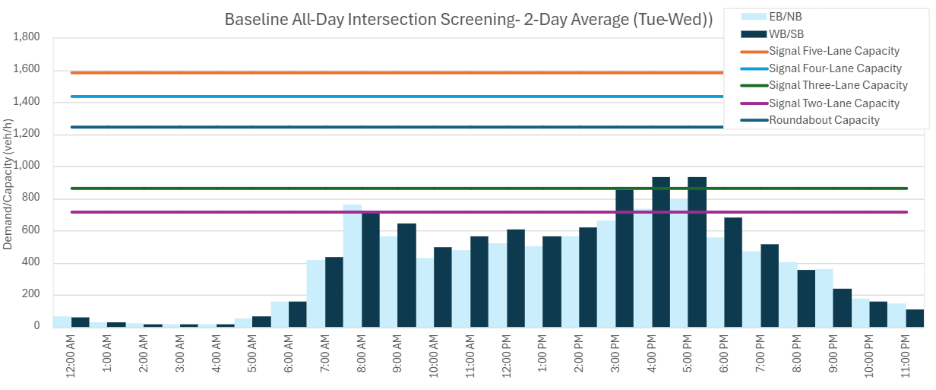
This project has been brought forward to implement the findings of the Ann Arbor Roadway Rightsizing (A2R2) project findings. The A2R2 study found that during most hours of the day the vehicle demand on the Broadway bridge segment can be serviced by fewer vehicle through lanes.
The project is an opportunity to partner with the Division Bikeway Expansion to further safety in this corridor by exploring ways to serve all existing and predicted road users in the area while improving safety outcomes.
What information was considered when starting this project?
Prior engagement, data, and analyses:
- Division Bikeway Expansion, Ongoing
- Ann Arbor Annual Transportation Survey, 2025 Edition
- Road Safety Audit, 2020
- Final Study, 2022
Cost and funding sources
Project design funding: FY27 Speed Management and Safety Funds
Check back soon!
Previous Engagement Opportunities
- Division Bikeway Expansion, Ongoing
- Ann Arbor Annual Transportation Survey, 2025 Edition
Upcoming Engagement Opportunities
- Join us for the project Open House on November 9th, 2026 at 5-7pm in City Hall Council Chambers. More details will be shared soon.
Share Your Feedback
Why a Lane Reconfiguration?
City Council has adopted policies that prioritize transportation safety, including reducing serious injuries and fatalities, as well as reducing vehicle miles traveled. City staff’s role is to apply those policies as individual projects are developed and evaluated.
For the Broadway Bridges and this area of Plymouth, the current analysis indicates that a three-lane configuration can accommodate existing traffic demand during the majority of the day with some inconvenience during three hours of the day. These traffic counts were collected in mid-September 2025 during mild weather, while schools and the University of Michigan were in session, to capture traffic conditions during a period of full activity.
Ann Arbor City Council adopted Vision Zero in October of 2015. The adoption of Vision Zero was a recommendation of the 2013 Pedestrian Safety and Access Task Force. This important work has continued through adoption of the city’s comprehensive transportation plan Ann Arbor Moving Together Towards Vision Zero (A2 Moving Together) as well as a series of council resolutions establishing a citywide goal of reducing vehicle miles traveled by 50%, directing staff to explore opportunities to speed management tools for all projects, and recommitting to achieving zero deaths on the network.
The following design priorities were developed in response to these directions from City Council.
- Safety of all road users: prevent fatal and serious injuries on our streets
- Pedestrian accessibility and mobility: provide safe, comfortable, accessible, and connected walking routes
- Bicycle and transit mobility: provide safe, comfortable, and reliable connections across the city
- General purpose vehicle operations: provide safe and predictable operations for drivers who use our streets
Safety Considerations
A2 Moving Together established strategies for identifying high crash locations, addressing existing crashes, and designing to prevent future crashes. Plan strategies to be employed by this project include:
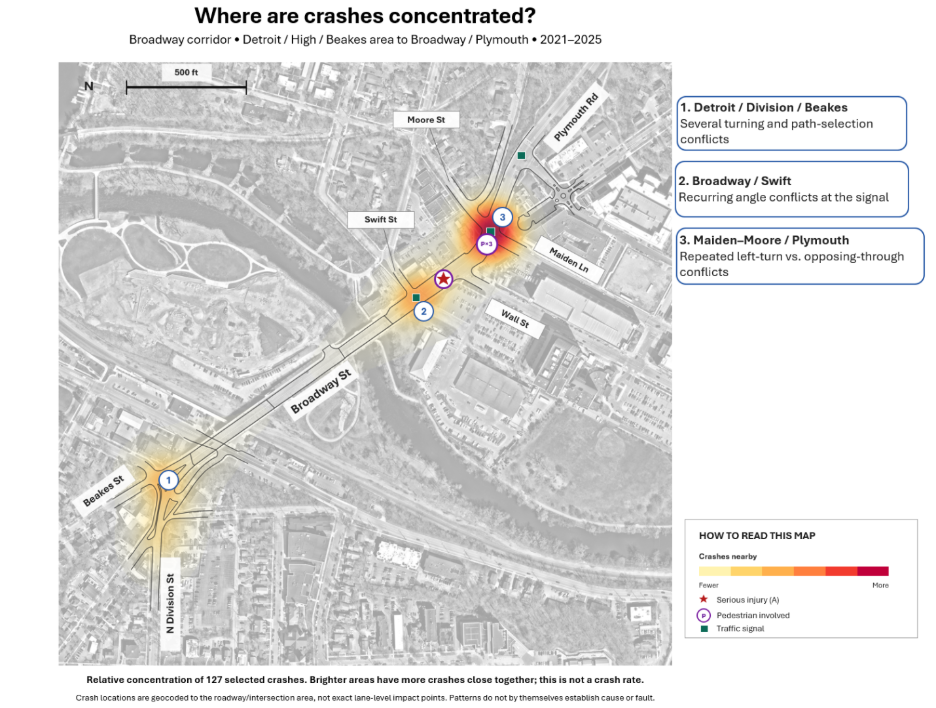
- High Crash Location: Broadway is a Tier 2 Corridor
- Address Dangerous Behaviors: Speed and Failure to Yield
- Crosswalk Safety: Improve crosswalk conspicuity
- Bike Routes: Eliminate cycling gaps and improve cycling connections to existing/proposed infrastructure
- Accessibility (ADA): Include audible/accessible pedestrian signals
- Signal Technology: Coordinate with adjacent projects to provide transit specific signals, address non-motorized needs, and update signal operations for general purpose vehicle lanes
Federal Highway Safe Systems strategies to be employed by this project include:
- Safe Speeds: using design to decrease operating speeds
- Safe Roads: employ proven safety countermeasures to prevent injuries
- Post Crash Care: employ a street design that ensures consistent emergency responder access
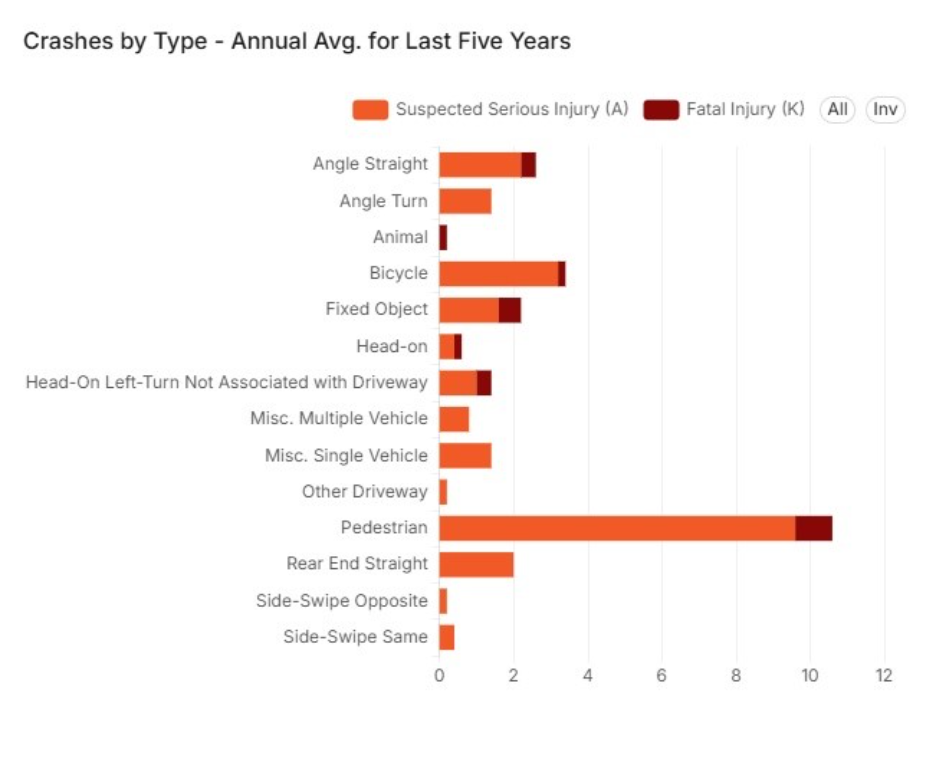
Staff will target systemic design countermeasures to prevent crashes based on citywide crash history for Fatal (K) and Suspected Serious Injury (A) crashes.
Conceptual Design
Coming soon!
The city’s consulting team is working on updates to the conceptual plans in response to project design requirement changes to satisfy the Ann Arbor Fire Department’s needs.


