Green Road
Plymouth Road to Burbank Dr.

This is the Engage Ann Arbor site for the Ann Arbor Roadway Rightsizing (A2R2) Project, which is developing and applying an approach for evaluating rightsizing opportunities on arterial streets.
Rightsizing means matching the design and allocation of street space to safety, community goals, and the transportation needs of each corridor. This may include reallocating general-purpose vehicle lanes for walking, bicycling or transit, or making other changes to reduce speeds and improve safety while retaining existing through lanes.
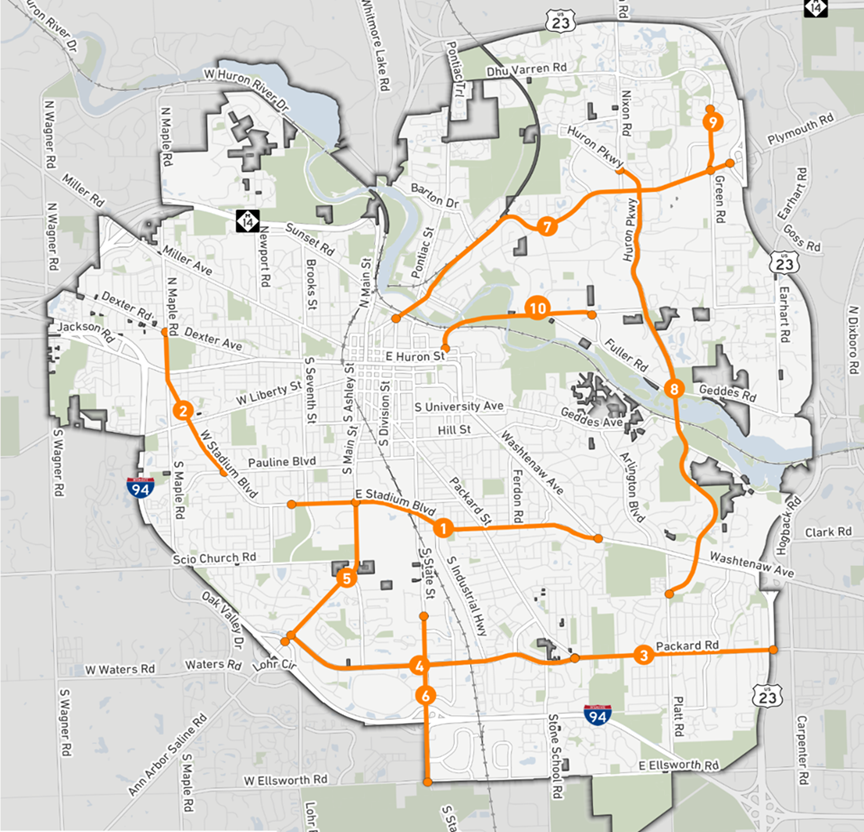 The goal of this study is to improve safety, reduce vehicle speeds, and enhance multimodal connectivity along arterial streets. This project will result in conceptual designs for the ten corridors that are responsive to the Moving Together Towards Vision Zero Transportation Plan and A2ZERO plan.
The ten A2R2 Corridors include:
Why is this project being done?
In 2021, the City of Ann Arbor adopted the Moving Together Towards Vision Zero Comprehensive Transportation Plan, which is organized around achieving two big goals:
In pursuit of these goals, the City recognizes that:
The Moving Together Towards Vision Zero Transportation Plan recognizes that a disproportionate number severe crashes occur on higher speed, wide arterial streets and intersections. As a step to direct attention and resources to the high crash severity streets, the City published a Speed Management Program and Toolbox, identifying a set of tools for street designs that produce lowered vehicle speeds and increased driver attention.
Understanding this, in November 2023, City Council passed Resolution R-23-415: Resolution to Accelerate Safety Improvements on Multilane Roads. This resolution directed the City Administrator and City Staff to develop a plan for evaluation of rightsizing all existing multilane roads under the City's jurisdiction by 2030.
Work to be done
The Ann Arbor Roadway Rightsizing (A2R2) project will evaluate the feasibility of “rightsizing” arterial streets. Rightsizing refers to re-purposing excess motor vehicle traffic lanes for other uses such as dedicated transit lanes, separated bike lanes, or additional sidewalk and amenity space.
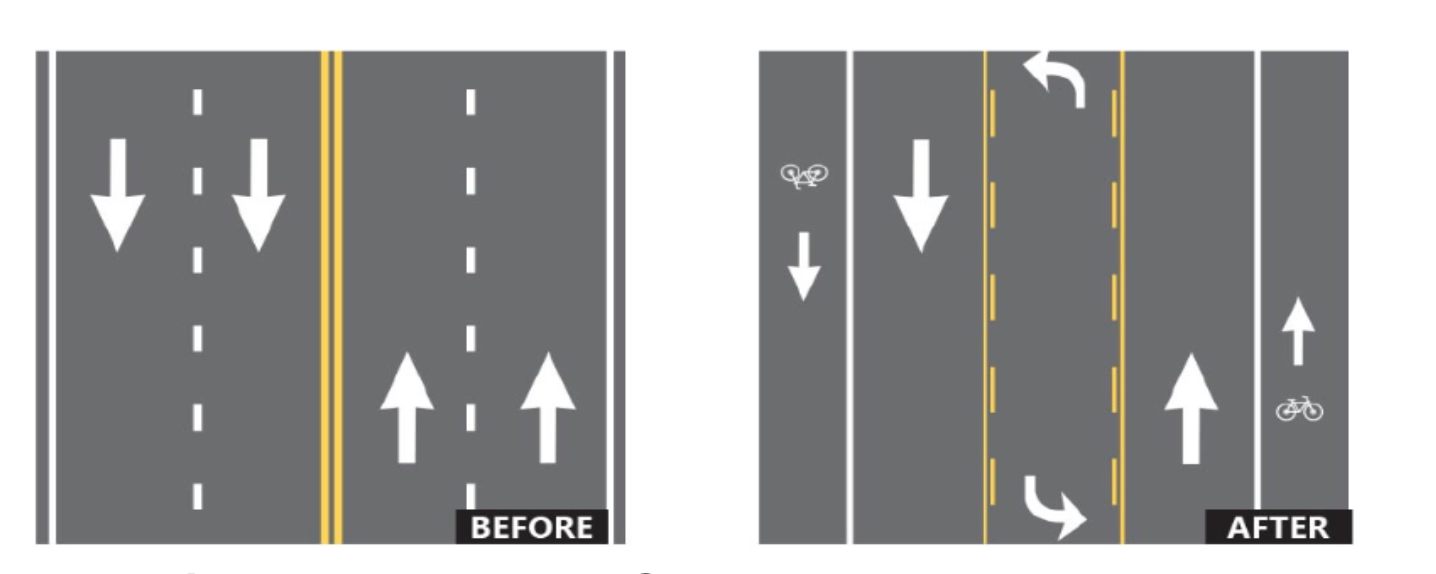
Figure 1: FHWA Proven Countermeasure Diagram
Roadway Rightsizing projects can reduce speeds, better organize traffic, address systemic safety issues, and incorporate planned transit and bicycle infrastructure throughout the City.
This project will result in conceptual designs for the ten corridors that are responsive to the Moving Together Towards Vision Zero and A2ZERO plan.Funding Source
Council-directed use of the city's major streets Act 51 resources.
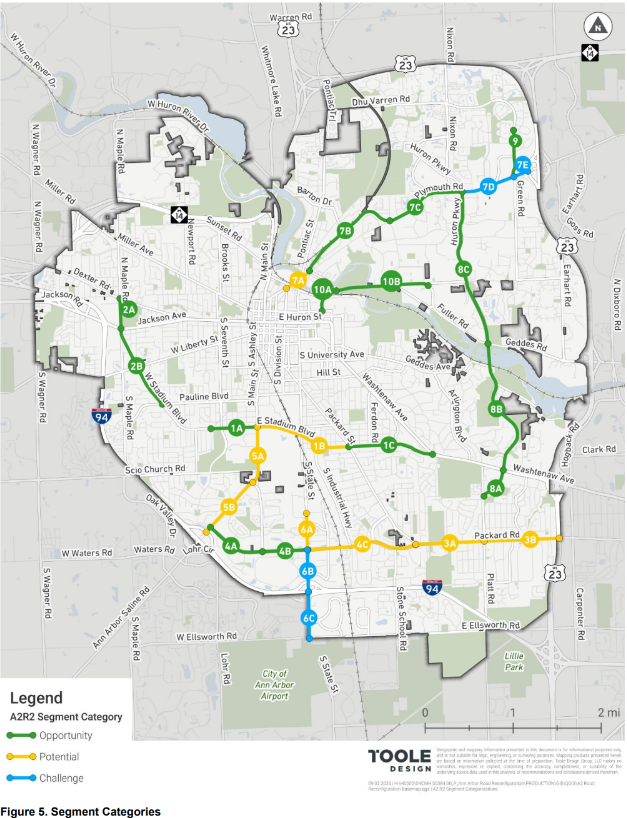
A2R2 evaluates 30 segments across ten corridors. Safety is the primary design objective. Traffic volumes help show how difficult it may be to reduce driving lanes and what additional work may be needed. These categories describe the difficulty of reducing lanes - not whether safety improvements are needed.
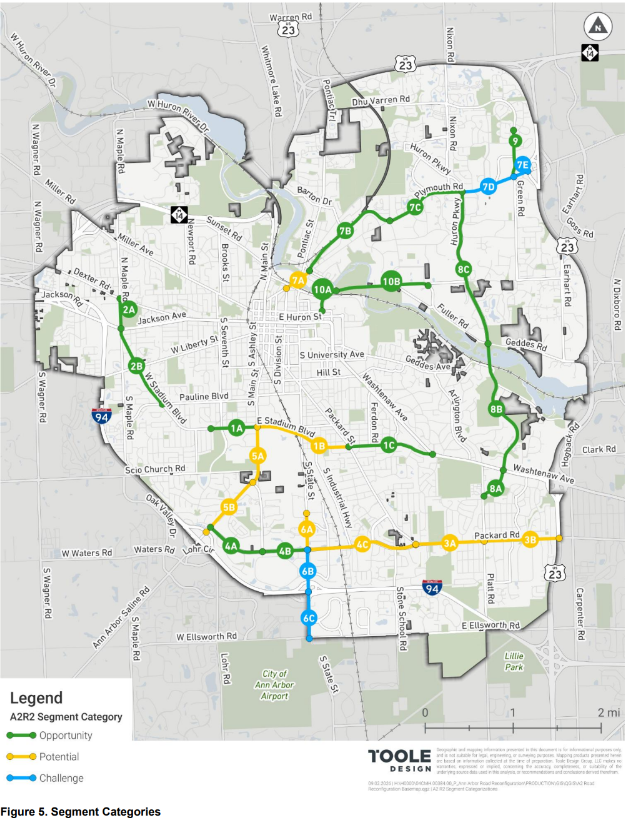
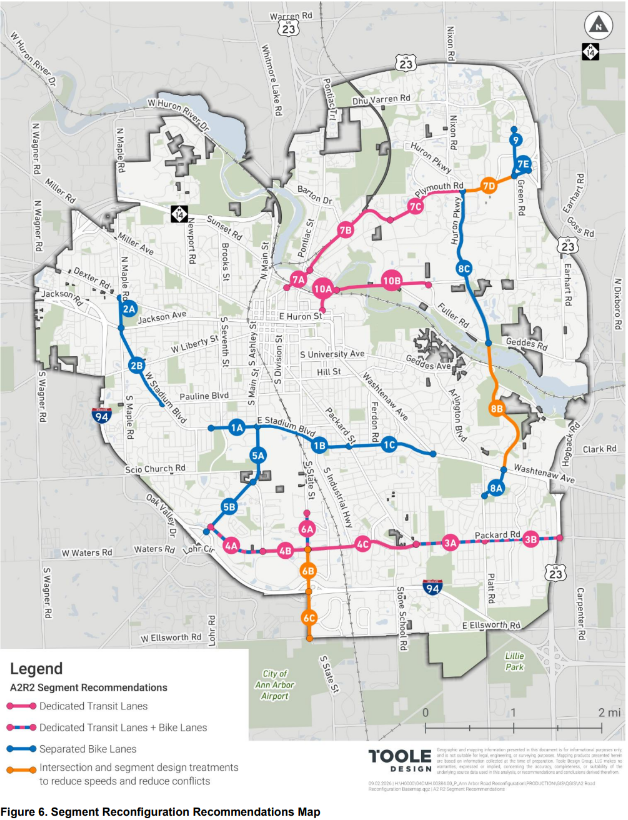
The study combines the screening results with safety needs, target speeds, adopted bicycle and transit plans, land-use context, and other corridor conditions to identify a recommended direction for each segment. Where driving lanes can be reallocated, the map shows what that space is recommended to support - transit, bicycling, or both. Where larger lane reductions are not recommended now, the map identifies segments where future work should focus on intersection and roadway design changes to reduce speeds and conflicts.
A street design priority framework for Ann Arbor
These priorities help determine an appropriate target speed and the street design needed to support it.
Small shifts in speed = big shifts in safety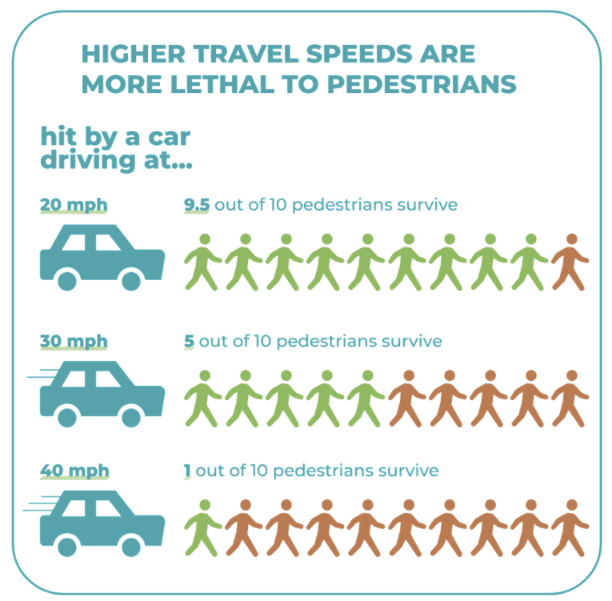
Traffic Operation Data Example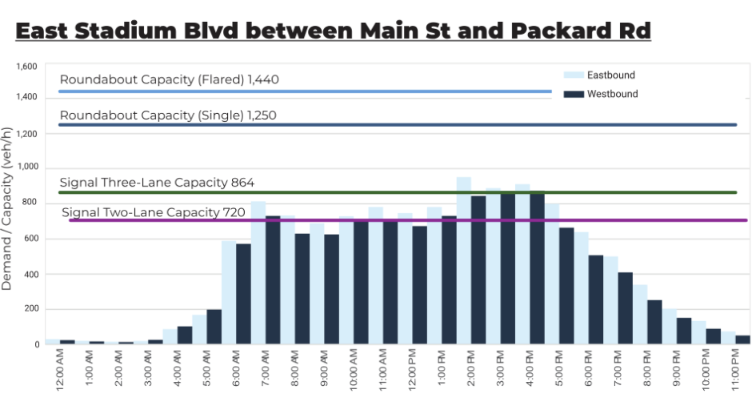
What this chart tells us: Traffic demand is concentrated in a limited number of peak hours; intersection design can help address those periods without allowing them alone to determine the street design for the full day.
Local Roadway Examples
The City of Ann Arbor has a long history of Roadway Rightsizing projects including these examples from the last decade:
Phase I Engagement Opportunities
Phase II Engagement Opportunities
A public open house was held on Thursday, October 22nd, 2026 at the Ann Arbor DDA. Both sessions were drop-in style and allowed attendees to explore project materials, talk with staff and share feedback.
1:00-3:00 p.m. and 5:30-7:30 p.m.
Engagement Boards
This project will result in conceptual designs for ten corridors that will apply proven safety countermeasures to improve safety, reduce vehicle speeds, and enhance multimodal connectivity along arterial streets. As individual projects advance into design, the City will use more detailed traffic analysis, including intersection and signal operations modeling, to evaluate potential queues and delays.
A2R2 does not complete final engineering design. Exact lane geometry, intersections, crossings, access, transit treatments, construction details, and implementation timing will be refined through future project design and project-specific engagement.
Plymouth Road to Burbank Dr.
From Washtenaw Ave. split to just west of 7th St.
Just southeast of Pauline Blvd. to Dexter Ave.
Eisenhower Parkway split to US-23
Ann Arbor-Saline Road to Packard St. split
Stadium Blvd. to I-94
Just north of Oakbrook Dr. to Ellsworth Road
US-23 to Division St. / Beakes St. Interchange
Platt St. split to Nixon Road
Catherine St. to Glazier Way

Have questions or want to learn more about a project, contact us below:
| Phone | 734.794.6000 |
|---|---|
| Website | www.a2gov.org |
| In writing | 301 E. Huron St. |


